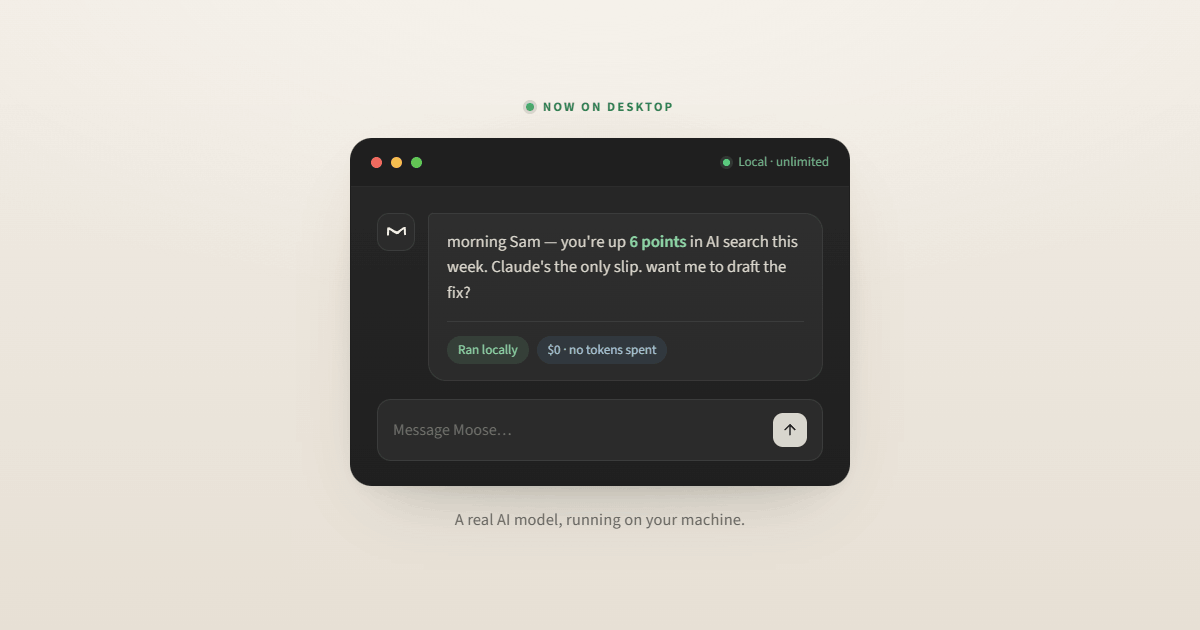
I rebuilt Hi, Moose around one belief: an AEO tool has to do the work, and the only way it can afford to do the work all day is if the AI runs on your own machine. Today that version ships - a desktop app for Windows and macOS with a real AI model on board.
This is the biggest thing I've built since starting the company, and the one I'm proudest of. Moose is no longer a tab you visit with a task in hand. It's a coworker that's already there when you sit down and remembers what you're working on. It doesn't do every job yet, but the jobs it does, it does end to end.
Tools that stop at the dashboard are going to lose their customers to tools that also do the work.
Where I think AEO tools are going
Questions that used to start with a Google search now start or finish in ChatGPT or Claude, and showing up in those responses takes a different approach than the traditional SEO playbook. The market has noticed. It seems like a new AI visibility tool launches weekly, and I suspect plenty of them are vibe-coded weekend projects - testing the waters, seeing what might earn some money. There's nothing wrong with that hustle, it's entrepreneurship. But it tells you what a visibility chart is worth on its own now: not much. When that many people can ship one in a weekend, it's a commodity.
Here's my prediction. The tools that don't adapt and move beyond dashboards are going to lose their customers to tools that offer both the visibility tracking and the ops work that follows it. A chart can tell you that you slipped in ChatGPT, but the real work starts after the chart, and that's where most tools clock out. The old Hi, Moose clocked out early too. On your own site the real work is a loop - watch, notice, write, approve, ship, watch again. Off your site it's earning the mentions and citations that answer engines lean on heavily.
Some teams already see this. The AEO ops side has been filling in over the last year, and the tools doing it well, like AirOps, are making product decisions based on real data and case studies rather than whatever is trending on LinkedIn. I respect what AirOps is building, it's a great solution. We overlap in places, but I'm building for a different customer: SMB. Making a connection with smaller teams and growing with them is more meaningful to me, and it's where I'd rather spend my energy when it also makes good business sense.
So a year after starting Hi, Moose as a set of point tools for my own SEO team, I threw the old shape out and rebuilt the whole product around where I believe this is going. To me, creating something that people love to use, get value from, and ultimately connect with is an art form. That's what I'm trying to make.
Why the AI has to live on your machine
The rebuild starts with a decision that sounds technical but is really about what the product can afford to do: Moose runs a real AI model locally, on your own computer.
Cost is the biggest reason. Marketing teams leaning on Claude are hitting real usage limits right now. Every metered token is a reason for a tool to do less: crawl fewer pages, check fewer prompts. A local model flips that. LLMs are powerful, and having one always available with no additional token cost opens up a world of possibilities. Moose can afford to re-crawl your site and re-check the engines as often as the job needs, because doing more doesn't cost either of us anything.
Speed comes with it. There's no round trip to a server, and it works offline.
Privacy is part of it too. Your prompts and drafts stay on your disk, along with any data you connect. And there's more to build here: paid plans can send individual tasks to cloud models, and I want to give those customers a hard lock that keeps everything local-only. That's on my list.
What shipped today
The model is Gemma, in three sizes so it fits the laptop you have:
- Gemma 2B - runs in 8 GB of RAM, near-instant replies. Great for older machines and lighter everyday tasks.
- Gemma 4B - the everyday default. Strong briefs and insights in around a second, on a 16 GB machine. Most people stay here.
- Gemma 26B - workstation muscle for long documents and dense research, on 32 GB.
It downloads once, then runs fully offline forever after. It uses your GPU when it can and your CPU when it can't. There's no meter, and you can talk to Moose all day at zero cost.
Getting there was a fight in places. Apple's Intel machines were the biggest struggle: no Apple Silicon to lean on, so efficiency stops being optional. We have to be super efficient with system prompts, balancing staying useful against giving the model enough context to work with. Every token spent on instructions is a token the model can't spend on your content.
Moose also learns your whole site. Every page, fetched and snapshotted locally, the way the AI crawlers see it. Ask a generic chatbot how your site is doing and you can't know what it looked at: sometimes it fetches a few pages, sometimes it answers from memory. Moose reads every page, which is how it catches the silent stuff - a CDN quietly turning away OpenAI's crawler, or content that only appears after JavaScript runs. It vectorizes what it finds, so you can ask which pages cover a topic and get an answer from your real site. And the visibility checks run from your machine and file their answers on your machine, so you're not paying a monitoring service per prompt.
When a job calls for a frontier model, you have two ways to reach one, and both stay in your control. Bring your own OpenRouter key (for OpenAI, Claude, Gemini, + several others) and Moose routes that one task to it - you pay the provider directly, at their rate, and I don't take a markup. Or go managed, and a paid plan runs the frontier models for you with no keys to juggle. Either way, the local model is always there underneath.
Next on the same foundation: an entity graph of what your site covers and how it connects, and deeper agent workflows that run longer multi-step jobs.
Moose is your coworker
What I most wanted this launch to feel like: an AEO expert who's always available. Moose greets you when you log on, and it remembers your projects and your voice.
Two commitments hold no matter what Moose grows into: nothing ships without your approval, and every recommendation is labeled by the evidence behind it - proven, directional, or best practice. I don't push tricks the research has debunked, and Moose never fabricates a citation to look smart.
Come say hi
I named the company after my dog - a steady, loyal one who lies under the desk through every late night. That's the temperament I built toward: something that's just there, on your side.
Hi, Moose for desktop is out now on Windows and macOS, and the local model is genuinely free - not a trial. Download it, put it on a real project, and tell me what you think. I will chat with anyone: [email protected] gets me.

Runs SEO by day and built Hi, Moose by night. No investors, no big team, just practical tooling for the AEO problems he kept hitting. Named the company after his dog.