The shortlist is the new page one.
AI is helping buyers build their shortlist before they visit your website.
Hi, Moose gives you the AI search intelligence infrastructure and forward-deployed AEO team to help your brand make the shortlist.

The shortlist.
Like most of us looking for a solution, we began that search on Google Search over the last 25 years. We type in a few words (we all got really good at this) and ultimately would click on a blue link, visit a website, and end up in a marketing funnel.
But since late 2022, something has changed, and continues to propagate. For many of us, across multiple demographics and verticals, we've migrated to a more buyer-friendly solution-finding experience, AI search.
For business owners and marketing teams, this shows up as a decline in organic search traffic, and it is happening to nearly everyone. Demand for most products hasn't gone anywhere. People are still searching. The top of the funnel has just moved off your website and into the AI answer.
And inside that answer, buyers search differently. They describe their situation in detail, explain their use case, and ask for the product most likely to fit. What comes back is a shortlist of a few names, not ten blue links. That shortlist is the new page one.

Who makes the list?
Naturally, the first thing most of us asked was, how does an LLM model decide? Where does the list come from? The short answer is, from us. From everything we've published over the years, the reviews and media we've earned, and everything others have written about us. The AI learned from it in training, and when a buyer asks a question today, it often improves its response by what it can find from a web search today.
The part we control most is our own website, and for a lot of us, the site has been telling the same human-centric story since the pre-AI search. Now, there is another type of visitor where we deliberately need to reduce the inference needed, say plainly what we do, who it's for, present real data, and back claims up with proof. From there the story spreads, to profiles and directories, to reviews, to comparison pages and forums, and eventually the press. The AI leans on what it sees repeated across sources it trusts.
Surprisingly, for well known big brands, it's not a shoo-in that they make the shortlist. Sure, it helps, but it's not a guarantee. A bigger/older brand, with more domain authority and backlinks, a larger ad budget, none of it guarantees a spot on the list. Each shortlist is an answer to one specific question, and the AI search model is going to pick the companies whose story (and proof) fits that question. We have seen well-known brands get left off answers that smaller competitors show up in, simply because the smaller competitor said it clearly, executed well on the details, and others repeated it.
Just your site. It has to tell your story on its own.

Are we on the shortlist?
Which brings us to the question that keeps us up at night. Are we on the buyer's shortlist or not? Back in the olden days (a few years ago), pre-AI search era, this was easy to answer. We tracked some keywords, got a position and a decent guess at search volume, and you knew where your brand stood. AI search doesn't work that way. There is no single static list to pull up.
Buyers ask hundreds of versions of the same question, conversing with AI in their own words, with their personalized chat history, across several models, and each answer is its own shortlist. Ask one prompt and we learn almost nothing. However, when you ask a few hundred, grouped by topic, a pattern shows up. Some brands keep reappearing. Those are the brands making the shortlists, the new page one.
So where your brand stands is a mention share, not a classic search engine ranking. It's how often your brand gets named across a topic, compared to how often your competitors get named. And since the same prompt can come back different under endless scenarios, and each AI model answers in its own way, that share has to come from asking many times, in each AI search system, over time.
Example data.
How often do we look?
How often do we need to check AI search results to understand how visible our brand is in AI search for the topics we care about? Not every change in AI search answers means something. Some of it is just the AI being the AI. Some of it is real. A new review landed, more news coverage, a competitor published a page, the model got an update.
Telling those two apart comes down to how many AI search answers sit behind each reading. We can get there with breadth (more prompts per topic) or with frequency (running the same prompts more often). Either way, a share built on a few hundred answers holds steady week to week, and when it does move, we can trust that it moved.
Each one tells us something different. Running the same 6 prompts every day shows how those 6 exact questions are moving. Running 40 different prompts under one topic once a week shows how the whole topic is moving, because those 40 cover more of the many ways different buyers ask about the same need. Across 8 AI search systems, that's 320 answers behind one weekly reading of the topic.
In Hi, Moose AI Visibility tracking, you can choose a custom schedule (multiple times per day, once daily, weekly, weekdays, etc.) that matches the needs of your business.
What do we do differently than SEO?
Most of what we learned doing SEO still holds. AI reads the same web we do, so a site that crawls cleanly, loads fast and answers the search query is still the starting point.
But the goal has shifted from earning clicks to earning a spot on the shortlist. In SEO, we created content that aligned to human users' search intent with a focus on keywords, and the page itself was what ranked. For AI Search (AEO) the top goal is being named. For the topics we care about, does the AI name us when a buyer asks? There are other goals too (being cited, being easy for the AI to extract from, being in the training data), but they sit under being mentioned. It stings to be cited as a source and still not named, which happens. So the weekly reading is about a different set of questions. Where are we named and where are we left out? Who got named instead? And did last month's updates show up in this month's answers?
Answering those takes the full history of what the AI search said, with sources and dates, so one week can be compared to the next. That is the layer Hi, Moose runs. It collects the answers, keeps them, and turns the differences into the list of what to change. The next chapters cover the ways to work with it: using your own AI assistant, working with our team, or using the Hi, Moose app.
 Checked visibility with Hi, MooseChecked site coverage with Hi, MooseWrote a content brief with Hi, Moose
- Captured 8 organic Google results for the topic
- Read 3 top-ranking pages and 2 pages cited by answer engines
- Captured 4 People Also Ask questions and 2 People Also Search For suggestions
- Google AI Overview, ChatGPT Search and 2 Gemini grounding queries for the topic
- Checked 1,240 indexed pages from your site crawl for existing coverage and internal link opportunities
- Used 6 sections from your uploaded brand documents
- Used the Brand Truth profile for audience, offerings, vocabulary and claim guidance
We already use Claude and ChatGPT. Isn't that enough?
Most of us lean on Claude or ChatGPT throughout our work day, so the natural move was to ask it: How do I optimize this page for AI search? Are we showing up for this topic? What should we change in this content? Claude and ChatGPT often come back deceptively confident with their answers. The trouble is what it doesn't have. It has no record of what the AI said about us at any point before now (not to mention not having a record of what other AI models have said), so it can't tell us what moved. It can't reliably read our whole site, so it doesn't know what we already cover, what to link to, or what's missing. It knows the general rules of AEO, but not our full situation nor our competitors.
Hi, Moose MCP fills that in. Connect it once, and Claude or ChatGPT can pull from what Hi, Moose has collected for your site: whether you are named or cited for a topic in each AI engine, now or months ago; what your site already covers; and the brief, draft, FAQs, internal links or AEO audit that come out of the work. You keep working in the chat you already use.
Human help.
Some teams already have the people and the process and just need the AEO tooling. For them, Chapter 6 and the app in Chapter 8 are the whole answer. Others want the tooling and a hand getting it connected, running and producing changes that hold. For those teams we offer forward-deployed AEO. Our SEO and AEO marketers and engineers connect Hi, Moose to the tools you already use (Claude, Slack, Search Console, your CMS), set up the monitoring around your buyers' questions, and work the weekly loop with your marketers until it runs on its own.
Underneath, the same Hi, Moose engine from the earlier chapters is doing the collecting and measuring, so the history we build with you is yours. If your team later takes the work in-house, or hands it to your own AI, nothing has to be rebuilt.
What if we want to run it ourselves?
Then the desktop app is for you. Hi, Moose started as an app for practitioners doing the work themselves, and the desktop app is still where the full workspace lives. It is the same app our team uses on client work, and everything in the earlier chapters is set up and run from here: the topics and prompts you track, the schedule, the AI engines, the history.
See where you are named and where you were left off, topic by topic and engine by engine, next to your competitors. Then write briefs, run AEO audits, set up workflows and publish to WordPress, Webflow or Grav. It runs on your Mac or PC, with a local model or your own API keys, so your data stays on your machine.
Free to start. See plans


So where do we start?
The shortlist is being built with or without us. The only question left is whether we can see it, and whether we can do something about it. Pick the way that fits your team. They all run on the same engine, so nothing is wasted if you change your mind later.
Add Hi, Moose MCP to Claude or ChatGPT and start asking where you are named. Free to try.
Add to Claude or ChatGPTThe desktop app for practitioners, on Mac or Windows. Free to start.
Download the appForward-deployed AEO. Our team connects Hi, Moose to your tools and works the weekly loop with you.
Talk to usBuilding your own product on top? MCP and the REST API are available now. Read the docs.

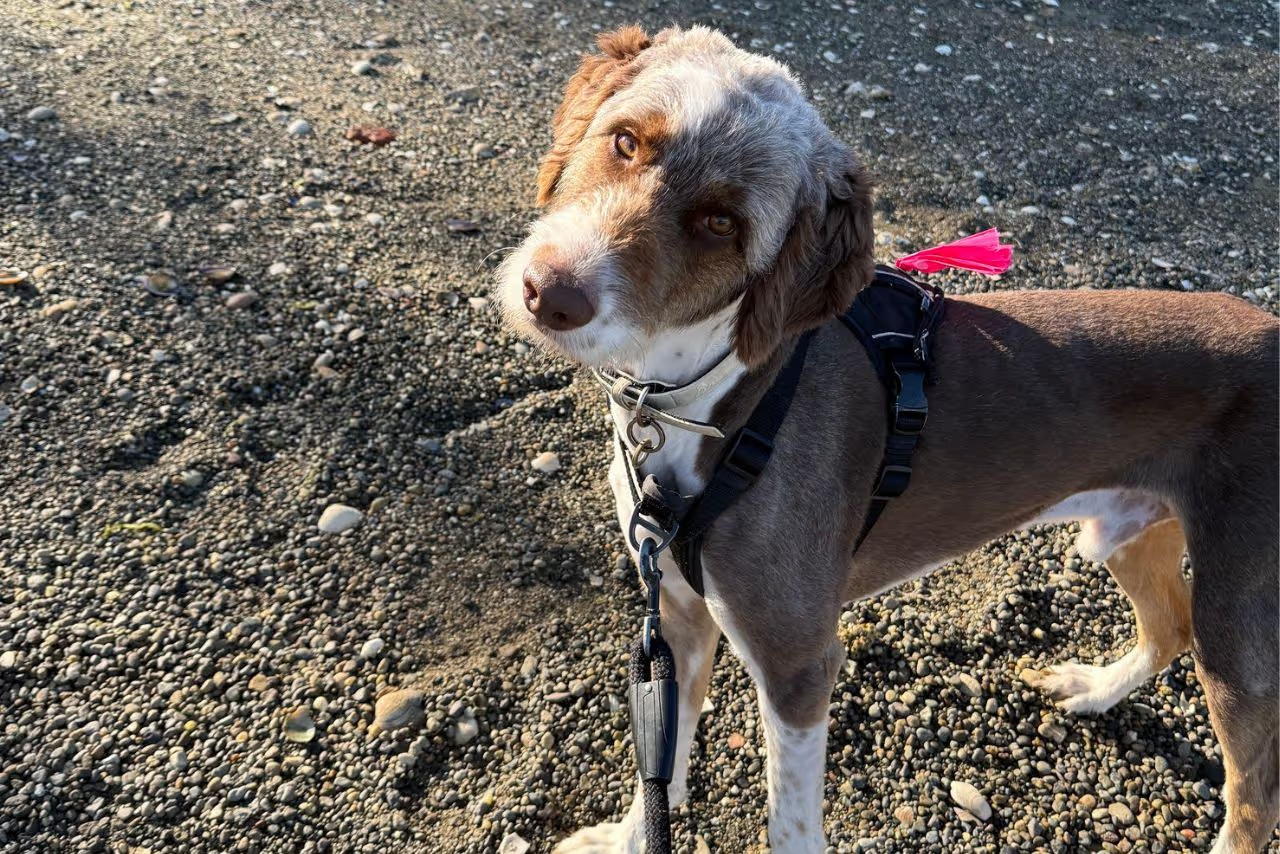
Serious AI search infra & tooling, named after this dude.
That's Moose. He had the name first. We got the website, the servers, and a job keeping up with AI search. He got the dog bed under the desk. He has the better arrangement, if you ask us.
If you hear snoring on a call with our team, that's him. Feel free to say hi.