Know what your site
already covers
Before you brief another post, ask whether you already wrote it. Moose crawls your site from your machine, keeps the index there, and answers with the pages, the verdict, and what is missing.
 SamPremium

Partly, Sam. You have the recipes. You do not have the answer. Four pages touch bread in a pizza oven, and none of them answers the question a buyer types.
So the pattern is method without explanation. Every page assumes you have already decided to bake bread and skips straight to grams and minutes. Nothing on the site says whether a pizza oven can hold 250°C long enough for a loaf, or how to stop the base scorching before the crumb sets.
That is the gap. One explainer that connects heat management to bread, linking down to the two recipes you already have, would give the engines something to cite and give the recipes an internal path. Right now the answer to that question is being written by forums.
Want me to open a brief for it, or check the same question against the Karu and Volt pages first?
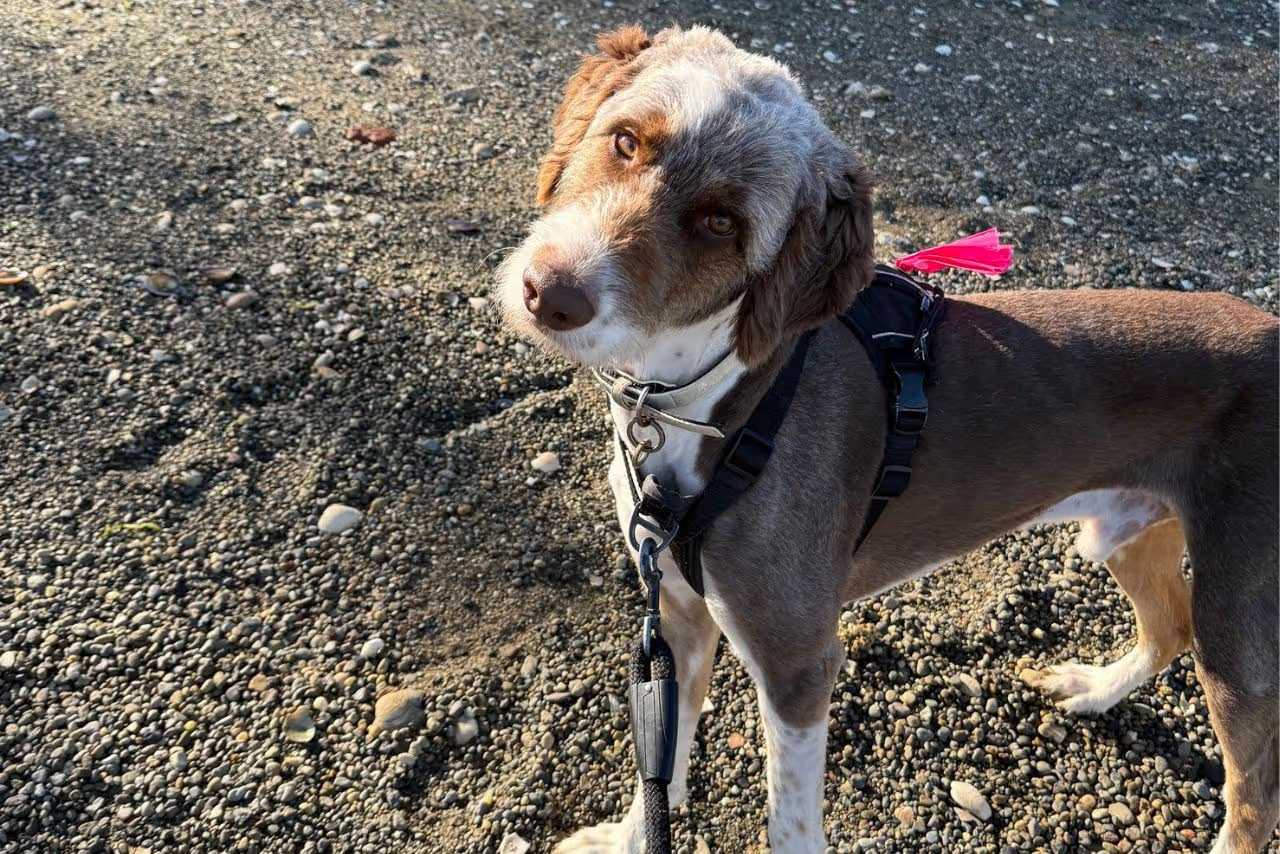
Chief desk supervisor. Has an excellent memory for where things are buried, though mostly in the garden. Consulted on this page.
Nobody knows what is on the site. Including the people who wrote it.
A site of any age outlives the memory of it. Twelve hundred pages, four writers, three CMS migrations, two people who have left. When a topic comes up, the honest answer is usually "I think we have something on that."
So you either write it again and split your own rankings, or skip it and leave a real gap open. Both cost more than checking would have. Checking properly, though, means reading pages, and nobody has an afternoon for that.
Keyword matches for "bread", ranked by whatever your CMS ranks by. It cannot tell you whether one of them answers the question, and it misses every page that says "loaf".
Four pages carry the method. None carries the reasoning. One explainer closes it, and it should link down to the two recipes rather than compete with them.
The questions you ask before you brief
All of them run against the local index, so the answer names real URLs from your own crawl. If a page is not in the crawl, Moose will not mention it.
Where the twelve-tabs check goes wrong
You know the routine: a site: search, a CMS search, twelve tabs, and a message in Slack to whoever has been there longest. It is slow, but slow is the smaller problem. These four are the ones that send you off to write the duplicate.
A page about listening to an article covers on-page audio and contains neither word in that order. Keyword search cannot see it, so you write the duplicate.
Plenty of pages promise a topic in the heading and never address it. Deciding needs the body text read, which is exactly what nobody has time to do.
Institutional memory of a site is held by two or three people and walks out with them. What is left is a sitemap nobody has read.
Two thin pages on one topic split links and confuse engines about which to cite. Merging them later is more work than checking would have been.
Crawl once, then just ask
The crawler runs from your machine and the index stays there. No upload, no third-party vector database, no waiting for a platform to finish processing your site.
Point Moose at the domain. It crawls at a rate you set, reads the real rendered text, and builds embeddings locally. A twelve hundred page site takes about twenty minutes.
Moose retrieves the closest pages by meaning, then opens them and reads. The verdict comes from the page text, not from the title or the URL slug.
Covered, so drop the idea. Partial, so update the page that is closest. Uncovered, so brief it. Every verdict is kept, so next quarter you can see what you decided and why.
The crawl, the page text and the embeddings all live in local storage on your computer. Nothing is uploaded to Hi, Moose. Run a local model and the verdicts are computed on your machine too, which matters if your site has staging URLs, client work or anything under an NDA in it.
"Do we cover this" is a judgement, not a search
A keyword hit is not coverage and a matching title is not coverage. Moose reads the page and rules on it, then tells you which rule it applied.
The index is embeddings over the real page text, so a question about on-page audio surfaces the page called "Listen to this article". Synonyms, product names and phrasing you did not think of all still land.
Retrieval only nominates candidates. A model then reads each one and decides whether it answers the question, because a matching title and a covered topic are different things.
Every URL in an answer comes from your crawl. Moose does not guess a plausible slug, and if the site has nothing on a topic it says nothing rather than reaching.
When several pages sit close together in the index, Moose flags the cluster and names which one is closest to the topic, so you know what to merge and what to keep.
A recipe, a product page and an explainer answer different queries. Moose reads the shape, which is why "you have the method but not the answer" is a verdict it can reach.
Covered, partial, uncovered
No score out of a hundred. Each verdict comes with the pages behind it and the next move it implies.
A page addresses the topic directly and in depth. Moose names it, quotes the part that carries the answer, and tells you it is already yours.
Pages touch the topic from the side, or cover the method without the reasoning. The most common verdict on a mature site, and the most useful one.
Nothing in the index addresses it, and Moose says so plainly rather than offering the nearest half-match as if it counted.
The check turns into the brief
Finding the gap is only useful if the next step is in the same window. It is.
Questions people ask
Do I need a sitemap or a CMS connection?
Neither. Moose crawls links the way an engine would, and a sitemap only helps it start faster. A CMS connection is for staging and publishing edits later in the loop, not for reading what is already live.
How big a site can it index?
Tens of thousands of pages is fine. Crawl rate is yours to set, so you can be gentle with a small server or fast on your own staging box. A twelve hundred page site is roughly twenty minutes, and re-crawls only fetch what changed.
What if a page covers the topic badly?
That is the partial verdict, and Moose says which part is missing rather than ticking the topic off. Covering a topic and answering a question are different bars, and the second one is what gets cited.
Does the index go stale?
It would, so re-crawl on a schedule. Moose keeps every crawl append-only, which means you can diff them: pages added, pages changed, pages gone. The verdict history sits alongside it, so you can see what you decided last quarter.
Do I need a paid plan?
No. Crawling and coverage questions run on BYOK Free with your own key or a local model. The crawl is your bandwidth and the compute is yours, so there is no meter on it.
More things to ask Moose
All use casesAsk why traffic moved and get an answer with the tables under it.
The searches Google writes for itself before it answers, and the domains it cites.
Twelve searches behind one prompt, including the site: queries naming brands it trusts.
The actual top ten, People Also Ask, and the AI Overview with its sources.
Share drops past your threshold, Moose finds the page, prepares the fix, waits for you.
The full list, and what Moose does step by step in each one.
Ask before you brief.
It takes one sentence.
Download Hi, Moose, crawl your site once, and find out what you already wrote before you write it again.